Scales, Chords, Regions, and Moves: The Building Blocks of Harmony in Orphere

Before you start searching for scales, comparing chords, or mapping out progressions in Orphere Studio, you need to understand the building blocks. Orphere organises harmony into a stack of core entities, where each layer builds on the one below it. Here’s what each one means and how they connect.
Notes
There are 12 pitch classes, numbered 0 to 11. A pitch class groups every octave of the same tone together: C4, C5, and C2 are different pitches, but they all belong to pitch class 0 (C). A note is a name assigned to a pitch class: for instance, C# and Db are both names for pitch class 1.
Notes are essential because harmony is built by combining them in unique ways.
Intervals
An interval is the distance between two notes. Each interval has a name (like “P5” or “m3”), a size in semitones, and a quality. The name of an interval combines a number with a quality. The number comes from counting the letter names between the two notes, inclusive: C to E spans three letter names (C, D, E), so it’s a “third”. The quality, perfect (P), major (M), minor (m), augmented (A), or diminished (d), specifies the exact size in semitones. C to E is a major third (M3, 4 semitones); C to Eb is a minor third (m3, 3 semitones).
Intervals matter because they determine the character of everything above them. The difference between a major chord and a minor chord is a single interval: the third. The difference between ionian and mixolydian is a single interval: the seventh. Orphere uses intervals as the foundation for constructing both scale types and chord types.
Degrees
A degree is a note’s role within a scale or chord, defined relative to the root or tonic. There are 7 degrees, numbered 1 through 7. The root is degree 1. A major third above it is degree 3. A flat seventh is degree b7.
Degrees carry more meaning than raw intervals because they encode both position and alteration relative to the major (ionian) scale. “b3” tells you it’s the third degree, lowered by a semitone from where it sits in the major scale. This is the language Orphere uses to describe what’s inside a scale or chord, and it’s what drives the naming system (covered in our posts on chord naming and scale naming).
Orphere classifies degrees into five modal categories: non-modal (1, 2, 4, 5), major (3, 6, 7), minor (b3, b6, b7), hyper-minor (bb3, b2, b4, b5), and hyper-major (#2, #4, #5, #7). These categories give you a quick read on the harmonic colour of any scale or chord.
Scales
A scale is a tonic note combined with a scale type. “C dorian” is the note C plus the dorian pattern of intervals. The scale type defines the structure; the tonic anchors it to a specific pitch.
A scale defines the pitch material available to you. When you load a scale into a slot, you’re choosing the harmonic territory for that moment in your music.
Chords
A chord is a root note combined with a chord type. “G dom7” is the note G plus the dominant seventh chord type (degrees 1, 3, 5, b7).
A chord creates a hierarchy among the notes in a scale. The chord tones are the most important notes at a given moment, while the remaining scale notes, the non-chord tones, take a supporting role. Where a scale sets the palette, a chord tells you which colours to foreground.
Regions
A region is a scale and a chord together. “C dorian + G min7” is a region. It represents a complete harmonic snapshot: the available pitches (the scale) and the emphasised pitches (the chord). Think of a region as a single frame of harmony. On its own, it tells you everything about the sound at one point in time.
Regions are the primary unit of harmonic identity in Orphere. When you load a scale into Slot A and a chord into Slot A, you’ve defined a region. The studio analyses the relationship between the scale and chord, including whether the chord is diatonic to the scale, what roman numeral it represents, and which notes fall outside the scale.
Moves
A move is the transition from one entity to another. You can have a scale move (one scale to another), a chord move (one chord to another), or a region move (one full region to another). If a region is a single frame of harmony, a move is the cut between two frames. It captures what changed, what stayed the same, and how far apart the two entities are.
Progressions
A progression is a sequence of regions. It’s the timeline of your harmonic plan: region 1 flows into region 2, which flows into region 3, and so on. Each adjacent pair of regions creates a move, and the chain of moves creates the harmonic arc of your piece.
Putting it all together in the Studio
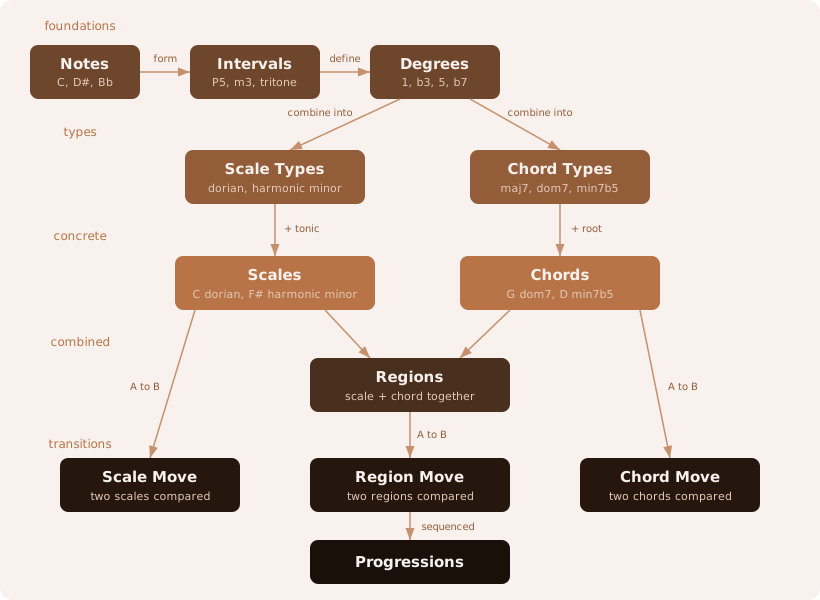
Here’s how it all stacks up. Notes form intervals. Intervals define degrees. Degrees combine into scale types and chord types. A type plus a note which defines the tonal centre, gives you a scale or a chord. A scale and a chord together form a region. The transition between two scales is a scale move, between two chords a chord move, and between two regions a region move. A sequence of regions, with the moves between them, forms a progression.
The studio is built around two slots, A and B. You load a region into each, a scale and a chord per slot. Slot A is where you are now. Slot B is where you might go next. Once both are loaded, the studio calculates the move between them.
Orphere makes your workflow open and exploratory. Start by choosing a scale and chord in Slot A, then browse destinations in Slot B. You can filter the palette by move properties, searching for scales within a certain voice leading distance, chords that are brighter than your current one, or regions that share common tones. When you find something you like, push it to your progression and keep going.