An instrument guide for contemporary composers: Families, groups, and registral areas
The contemporary composer’s palette reaches far beyond the classical orchestra. A single cue might call for bass flute and cimbasso, junkyard metals and a children’s chorus, an electric bass under a string section. Choosing among all of them starts with two questions: what kind of instrument is it, and where does it sit?
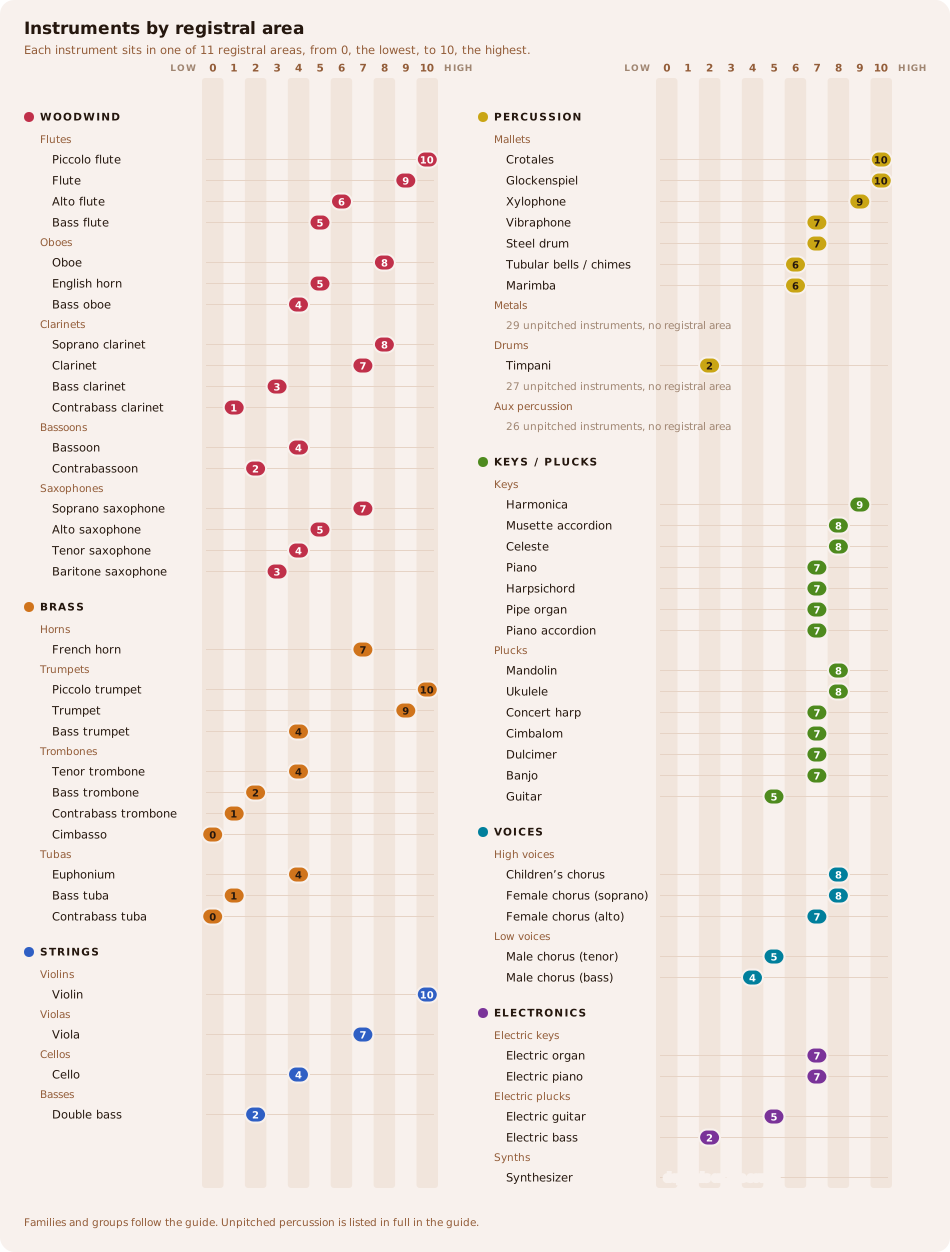
This guide answers both. It groups more than 140 instruments into seven families and their groups, and places every pitched instrument in one of 11 registral areas, from 0, the lowest, to 10, the highest. The chart gives you the whole picture at a glance, and the sections after it give sounding ranges, transpositions and practical notes for each group.
How the guide is organised
Every instrument belongs to a family and, within it, a group:
- Woodwind: flutes, oboes, clarinets, bassoons and saxophones
- Brass: horns, trumpets, trombones and tubas
- Percussion: mallets, metals, drums and auxiliary percussion
- Keys / Plucks: keyboard instruments and plucked or struck strings
- Voices: high and low choral voices
- Strings: violins, violas, cellos and basses
- Electronics: electric keys, electric plucks and synths
Each pitched instrument then has a registral area: where its characteristic sound sits in the overall register, on a scale of 0 to 10. Area 0 is the deepest, home of the cimbasso and contrabass tuba. Area 10 is the highest, where the piccolo, crotales and violin sing. The areas describe where an instrument does its typical work, not the full extent of its range, which is why a violin and a piccolo can share area 10 even though the violin reaches much lower.
The chart
Using registral areas
Plan your layers by area. Clear orchestration usually gives each layer of the texture its own area: a bass line in areas 1 to 2, harmony in 4 to 7, melody in 8 to 10. When two layers sit in the same area, they compete for the listener’s attention.
Double within an area to blend, across areas to reinforce. Instruments in the same area merge into a new colour, like flute and violin in areas 9 and 10, or clarinet, horn and viola in area 7. Doubling a line an octave or more apart, from area 4 to area 8 for instance, makes it stronger without changing its colour as much.
Watch the crowded middle. Area 7 holds more instruments than any other: clarinet, soprano saxophone, horn, vibraphone, steel drum, piano, harp, the altos, viola and the electric keys. It’s where warmth comes from, but also where a texture turns to mud. Thin it out when the melody needs space.
Space chords widely in the low areas. Areas 0 to 3 belong to few instruments, and for good reason: close intervals sound muddy down there. Let the bass instruments play roots and fifths, and save thirds and denser intervals for area 4 and above.
Remember written and sounding pitch. Many instruments in this guide transpose: they read music at a different pitch from the one they produce. The tables give sounding ranges, what the audience hears, with each instrument’s transposition in the notes. Pitches use scientific pitch notation, where C4 is middle C. Ranges are approximate: sources disagree by a step or two at the extremes, and individual players vary.
Woodwind
Woodwinds span the full register, from the contrabass clarinet in area 1 to the piccolo in area 10. Each group has its own colour, so a woodwind section is really five small sections that can blend or stand apart.
Flutes
| Instrument | Area | Sounding range | Notes |
|---|---|---|---|
| Piccolo flute | 10 | D5–C8 | Sounds an octave higher than written |
| Flute | 9 | C4–D7 | Non-transposing, B3 with a B foot |
| Alto flute | 6 | G3–G6 | In G, sounds a perfect fourth lower than written |
| Bass flute | 5 | C3–C6 | In C, sounds an octave lower than written |
The flute’s low register is soft and breathy and disappears under heavy textures, while its top octave cuts through anything. The alto and bass flutes extend that hushed, airy low register downward: beautiful when exposed, easily covered otherwise, and often amplified in contemporary scores.
Oboes
| Instrument | Area | Sounding range | Notes |
|---|---|---|---|
| Oboe | 8 | B♭3–A6 | Non-transposing |
| English horn | 5 | E3–C6 | In F, sounds a perfect fifth lower than written |
| Bass oboe | 4 | About B2–G5 | In C, sounds an octave lower than written |
The oboe’s penetrating, reedy tone carries a melody through a full texture, though its lowest notes are hard to play softly. The English horn, also called cor anglais, is prized for its plaintive middle register. The bass oboe is rare, a darker, rounder voice an octave below the oboe, and a close relative of the heckelphone.
Clarinets
| Instrument | Area | Sounding range | Notes |
|---|---|---|---|
| Soprano clarinet | 8 | About G3–C7 | The E♭ clarinet, sounds a minor third higher than written |
| Clarinet | 7 | D3–B♭6 | In B♭, sounds a major second lower than written |
| Bass clarinet | 3 | B♭1–F5 | In B♭, sounds a major ninth lower than written (treble clef), low C extension for the bottom notes |
| Contrabass clarinet | 1 | About B♭0–F3 | In B♭, sounds two octaves and a major second lower than written |
The clarinet has the widest dynamic range of the woodwinds, from almost nothing to full, and distinct registers: the dark chalumeau at the bottom and the bright clarion above. The E♭ soprano clarinet is shrill and biting at the top, ideal for grotesque or folk colours. The bass and contrabass clarinets give the woodwinds a smooth, agile bass.
Bassoons
| Instrument | Area | Sounding range | Notes |
|---|---|---|---|
| Bassoon | 4 | B♭1–E5 | Non-transposing |
| Contrabassoon | 2 | B♭0–B♭3 | Sounds an octave lower than written |
The bassoon is reedy in its low register and distinctive, slightly strained, in its tenor register, a favourite for melancholy solos. The contrabassoon usually doubles the basses an octave down. Its lowest notes are slow to speak, so avoid fast passages there.
Saxophones
| Instrument | Area | Sounding range | Notes |
|---|---|---|---|
| Soprano saxophone | 7 | A♭3–E♭6 | In B♭, sounds a major second lower than written |
| Alto saxophone | 5 | D♭3–A♭5 | In E♭, sounds a major sixth lower than written |
| Tenor saxophone | 4 | A♭2–E♭5 | In B♭, sounds a major ninth lower than written |
| Baritone saxophone | 3 | D♭2–A♭4 | In E♭, sounds an octave and a major sixth lower than written, C2 with a low A key |
All four saxophones share the same written range, so the same fingering works across the family. Brass-bodied with a single reed, they bridge woodwind and brass, blend well with horns and trombones, and can play far above these ranges in the altissimo register in skilled hands.
Brass
Brass covers areas 0 to 10 with more power than any other family. The trombones and tubas own the very bottom of the register, while the trumpets and horns carry fanfares and melody.
Horns
| Instrument | Area | Sounding range | Notes |
|---|---|---|---|
| French horn | 7 | B1–F5 | In F, sounds a perfect fifth lower than written |
The horn is the most versatile brass instrument, blending with woodwinds and strings as easily as with brass. Its low notes need time to speak, and its top register is strenuous, so give long high passages to more than one player.
Trumpets
| Instrument | Area | Sounding range | Notes |
|---|---|---|---|
| Piccolo trumpet | 10 | D4–G6 | In high B♭, sounds a minor seventh higher than written (also made in A) |
| Trumpet | 9 | E3–C6 | In B♭, sounds a major second lower than written |
| Bass trumpet | 4 | E2–C5 | In B♭, sounds a major ninth lower than written |
The trumpet is brilliant at the top and warm in the middle, but endurance matters, so build in rests. The piccolo trumpet brings the baroque clarino sound and a gleaming top line, often doubling oboes. The bass trumpet, introduced by Wagner, has a noble, trombone-like tone and is usually played by trombonists.
Trombones
| Instrument | Area | Sounding range | Notes |
|---|---|---|---|
| Tenor trombone | 4 | E2–F5 | Non-transposing, pedal tones below |
| Bass trombone | 2 | B♭1–B♭4 | Non-transposing, valves fill the low register |
| Contrabass trombone | 1 | A♭0–C5 | Non-transposing, usually in F with two valves |
| Cimbasso | 0 | F1–F4 | Non-transposing, in F or E♭, played seated with a forward-facing bell |
The slide makes glissandos natural on every trombone. The contrabass trombone gives the section a deep, stable foundation, often as the fourth trombone. The cimbasso, a valved instrument from Italian opera and a mainstay of film scoring, has a focused, brassy bass that blends with trombones better than a tuba.
Tubas
| Instrument | Area | Sounding range | Notes |
|---|---|---|---|
| Euphonium | 4 | B1–B♭4 | Non-transposing in bass clef, treble clef parts sound a major ninth lower |
| Bass tuba | 1 | D1–F4 | Non-transposing |
| Contrabass tuba | 0 | A0–B3 | Non-transposing, in B♭ or C |
The euphonium has a warm, singing tenor voice. The bass tuba is more agile than its size suggests, while the contrabass tuba is richer and darker but slower, better suited to stately lines. Both need time to breathe in sustained bass parts.
Percussion
Percussion is the largest family by far, and most of it is unpitched. Only the mallets and timpani have registral areas; metals, drums and auxiliary percussion are chosen for colour, attack and resonance instead.
Mallets
| Instrument | Area | Sounding range | Notes |
|---|---|---|---|
| Crotales | 10 | C6–C8 | Small tuned discs, sound two octaves higher than written |
| Glockenspiel | 10 | G5–C8 | Sounds two octaves higher than written |
| Xylophone | 9 | F4–C8 | Sounds an octave higher than written |
| Vibraphone | 7 | F3–F6 | Non-transposing, sustain pedal and motor-driven vibrato |
| Steel drum | 7 | About D4–F♯6 | The tenor (lead) pan, lower pans extend a steel band down to the bass |
| Tubular bells / chimes | 6 | C4–F5 | Non-transposing, pitch can sound ambiguous |
| Marimba | 6 | A2–C7 | Five-octave instruments reach C2 |
Crotales and glockenspiel ring like bells over any texture. The xylophone is dry and short, ideal for crisp doubling. The vibraphone sustains, and the marimba’s lower register is warm and resonant. The steel drum, from Trinidad and Tobago, sits beside the vibraphone in area 7, with a bright, singing tone. Its range here is the tenor pan’s: a full steel band adds lower pans down to the bass.
Metals
| Instrument | Notes |
|---|---|
| Junkyard metals | Found scrap metal struck with sticks or hammers, raw and industrial |
| Pole | A struck metal pole or pipe, a ringing, clanging tone |
| Crowbar | A struck steel bar, bright and piercing with a long ring |
| Tank | A struck metal tank, booming and resonant |
| Shells | Struck metal shell casings, short and bell-like |
| Gong | A tuned or nipple gong with a clear central pitch and a long decay |
| Bowl | A singing or Tibetan bowl, struck or rubbed for a sustained, shimmering tone |
| Waterphone | A steel resonator with bronze rods, bowed or struck, eerie and gliding as the water inside moves |
| Cowbell | A clanking bell without a clapper, struck with a stick |
| Cymbal | A suspended cymbal, rolled or struck, from shimmer to crash |
| Piatti | Orchestral clash cymbals, a pair struck together |
| Railroad bell | A large, heavy bell with a deep, ringing clang |
| Ship bell | A bronze bell with a clear, carrying tone |
| Jingle bell | Small bells on a strap or stick, shaken, a festive jingle |
| Tamtam | A large unpitched gong, a roaring swell when struck or rubbed |
| Tambourine | A frame with jingles, shaken, struck or rolled |
| Sheet | A thunder sheet, a large suspended metal sheet shaken for thunder |
| Triangle | A bent steel bar, bright and ringing |
| Musical saw | A handsaw bowed for an eerie, sliding, vocal tone |
| Aluphone | Aluminium bells tuned like a glockenspiel, with untuned overtones for a bell-like shimmer |
| Agogo | A pair of tuned bells from West Africa and Brazil, struck for samba patterns |
| Hand bell | A tuned bell rung by hand, sweet and sustained |
| Anvil | A struck steel anvil or metal block, hard and ringing |
| Bell tree | Nested bells struck in a glissando, a sparkling cascade |
| Can | A struck tin or metal can, short and tinny |
| Dumpster | A struck metal dumpster, a huge, hollow boom |
| Chains | Metal chains shaken or dropped, rattling and heavy |
| Ribbon crasher | Stacked metal ribbons struck with sticks, a bright, trashy crash |
| Musical glass | Wine glasses or a glass harmonica rubbed for a pure, ethereal tone |
Metals give contemporary scores their sense of space and threat: the long decay of a tamtam, the industrial crack of junkyard metals, the shimmer of a bowed cymbal or waterphone. Many of them sound very different struck, scraped, bowed or rubbed, so say how you want each one played.
Drums
| Instrument | Area | Notes |
|---|---|---|
| Timpani | 2 | Tuned kettledrums, a set of four covering about D2 to C4, each drum about a fifth |
| Box | A struck wooden box, dry and woody | |
| Nagara / nagada | A pair of kettledrums from India and the Middle East, played with sticks | |
| Snare drum | Wires across the lower head give its crisp rattle | |
| Bongo | A pair of small, high Cuban hand drums | |
| Kngu / kaganu | The smallest, highest drum of the Ewe ensemble of Ghana and Togo, played with two sticks to drive the polyrhythm | |
| Conga | Tall Cuban hand drums with a deep, singing tone | |
| Field drum | A deep military snare drum, darker than the orchestral snare | |
| Tenor drum | A deep drum without snares, a muffled, martial tone | |
| Timbale | Shallow metal-shelled Cuban drums, bright and cutting | |
| Dumbek / darbuka | A goblet drum from the Middle East and North Africa, with a deep “doum” and sharp “tek” | |
| Bass drum | The deepest orchestral drum, from soft rumble to thunderous hit | |
| Tube drum | A tall, tubular hand drum, open at the bottom | |
| Dhol | A double-headed barrel drum from South Asia, loud and driving | |
| Tupan | A Balkan double-headed bass drum, played with a beater and a switch | |
| Udu | A clay pot drum from Nigeria, with a liquid, bass-heavy tone | |
| Buffalo drum | A Native American frame drum with a rawhide head, deep and resonant | |
| Hand drum | Any small drum played with the hands | |
| Oil drum | A struck steel barrel, hollow and metallic | |
| Frame drum | A shallow, wide drum, from tambourine size to the large bendir | |
| Spring drum | A tube with a long spring attached to its head, shaken for a rumbling thunder effect | |
| Dunun / djun | The bass drums of West African djembe ensembles, played with sticks and bells | |
| Boom | A deep, cinematic low hit | |
| Octoban | Long, narrow tom-toms tuned in a melodic scale | |
| Roto tom | A frameless drum tuned by rotating it, with a clear, adjustable pitch | |
| Taiko | Large Japanese drums with a massive, thunderous attack | |
| Surdo | A large Brazilian bass drum, the heartbeat of samba | |
| Tom | Tom-toms, pitched in sets from high to low |
Drums are where most of the energy in a modern score comes from. Mix families freely, taiko with dhol, surdo with orchestral bass drum, but give each one a clear role in the rhythm so they don’t blur together.
Aux percussion
| Instrument | Notes |
|---|---|
| Plastic | Struck or scraped plastic objects, such as buckets and tubes |
| Rattle | Any shaken rattle, from gourds to seed pods |
| Ratchet | A cog and wooden tongue, cranked for a loud, rasping clatter |
| Guiro | A ridged gourd scraped with a stick, from Latin America |
| Wind chimes | Hanging chimes brushed for a gentle, random shimmer |
| Bird call | A whistle that imitates birdsong |
| Body percussion | Claps, stamps, slaps and clicks from the performers’ bodies |
| Cab horn | A taxi or bulb horn, honked for comic or urban colour |
| Castanets | Clapped shells, from Spain, crisp and rhythmic |
| Clave | Two hardwood sticks struck together, the key of Cuban rhythm |
| Cuckoo | A whistle that imitates the cuckoo’s two notes |
| Duck call | A reed call that imitates a duck’s quack |
| Foghorn | A deep, blaring horn for maritime or industrial colour |
| Shaker | A sealed container of beads or seeds, shaken in rhythm |
| Maracas | A pair of shaken rattles from Latin America |
| Sticks | Drumsticks struck together or on surfaces, dry and percussive |
| Temple blocks | Hollow wooden blocks in graded pitches, a clip-clop tone |
| Vibraslap | A wooden ball on a wire and a box of rattling pins, a buzzing rattle |
| Woodblock | A hollow wooden block, sharp and dry |
| Tikitaka | A small wooden clicker |
| Cabasa | Steel beads wrapped around a cylinder, twisted for a scraping shake |
| Cajita | A small Afro-Peruvian box, its lid clapped and its sides struck with a stick |
| Cup | Struck or tapped cups, short and bright |
| Windmaker | A wind machine, cloth turned over a drum for the sound of wind |
| Rainmaker | A rainstick, pebbles falling through a cactus tube for the sound of rain |
| Cajon | A Peruvian box drum, played seated, with a deep bass and snappy top |
Auxiliary percussion adds texture, humour and place. A few well-chosen colours, a ratchet at a climax, a rainmaker under a quiet passage, often do more than a full kit.
Keys / Plucks
Keyboards and plucked strings cluster in areas 5 to 9, where their attack and resonance add definition to the harmony.
Keys
| Instrument | Area | Sounding range | Notes |
|---|---|---|---|
| Harmonica | 9 | C4–D7 | A chromatic 12-hole harmonica in C, diatonic models in every key |
| Musette accordion | 8 | About F3–A6 | Wet-tuned treble reeds give its tremolo, French musette tone |
| Celeste | 8 | C4–C8 | The celesta, sounds an octave higher than written |
| Piano | 7 | A0–C8 | The full range of the keyboard |
| Harpsichord | 7 | About F1–F6 | Plucked strings, no dynamic control by touch |
| Pipe organ | 7 | About C0–C9 | Manuals C2–C7 at 8′ pitch, stops from 32′ to 2′ extend the sound |
| Piano accordion | 7 | About F3–A6 | Treble keyboard, plus bass buttons for bass notes and chords |
The keys can play harmony and melody at once, which makes them ideal for filling in the middle of a texture. The celesta and harmonica sparkle at the top, the accordion brings folk and café colour, and the pipe organ has a range and power no other instrument matches.
Plucks
| Instrument | Area | Sounding range | Notes |
|---|---|---|---|
| Mandolin | 8 | G3–A6 | Tuned like a violin, tremolo for sustained notes |
| Ukulele | 8 | C4–A5 | A soprano ukulele with a re-entrant high G string |
| Concert harp | 7 | C♭1–G♯7 | Seven pedals set one spelling of each note name |
| Cimbalom | 7 | E2–A6 | A Hungarian hammered dulcimer, struck with beaters |
| Dulcimer | 7 | About D3–E6 | A hammered dulcimer, struck with light hammers, about three octaves on a common 16/15 instrument |
| Banjo | 7 | D3–B5 | A five-string banjo, bright and percussive |
| Guitar | 5 | E2–B5 | Sounds an octave lower than written |
The plucks give the harmony attack and decay instead of sustain. The harp is tuned to one seven-note scale at a time, so chromatic passages need pedal changes. The cimbalom and hammered dulcimer bring a shimmering, struck resonance, and the mandolin, ukulele and banjo bring folk colour.
Voices
| Instrument | Group | Area | Sounding range | Notes |
|---|---|---|---|---|
| Children’s chorus | High voices | 8 | About A3–F5 | Pure, light tone |
| Female chorus (soprano) | High voices | 8 | About C4–A5 | |
| Female chorus (alto) | High voices | 7 | About G3–D5 | |
| Male chorus (tenor) | Low voices | 5 | About C3–A4 | Written in treble clef an octave higher than it sounds |
| Male chorus (bass) | Low voices | 4 | About E2–D4 |
Voices bring words and the most human colour of all. Choral ranges are narrower than solo ranges: keep sustained writing in the middle of each range, and save the extremes for climaxes. High voices sit in areas 7 to 8, low voices in 4 to 5.
Strings
| Instrument | Group | Area | Sounding range | Notes |
|---|---|---|---|---|
| Violin | Violins | 10 | G3–A7 | A section stays secure to about A6 |
| Viola | Violas | 7 | C3–E6 | Alto clef, treble clef for high passages |
| Cello | Cellos | 4 | C2–A5 | Bass clef, tenor and treble clef for high passages |
| Double bass | Basses | 2 | E1–G4 | Sounds an octave lower than written, C1 with a low C extension |
Strings are the most flexible family: they sustain, blend, play every dynamic and can change colour with a single technique, from sul ponticello to harmonics. The violins carry the top line in area 10, the violas fill area 7, the cellos sing in area 4, and the basses anchor area 2.
Electronics
| Instrument | Group | Area | Sounding range | Notes |
|---|---|---|---|---|
| Electric organ | Electric keys | 7 | About C1–C9 | A tonewheel organ like the Hammond, manuals C2–C7 with drawbars from 16′ to 1′ |
| Electric piano | Electric keys | 7 | About E1–E7 | A 73-key Rhodes, Wurlitzers have a shorter range |
| Electric guitar | Electric plucks | 5 | E2–E6 | Sounds an octave lower than written |
| Electric bass | Electric plucks | 2 | E1–G4 | Sounds an octave lower than written, B0 on a five-string bass |
| Synthesizer | Synths | Depends on the sound | Any | Range and register depend entirely on the patch |
Electronics extend the acoustic palette in every direction. The electric bass doubles or replaces the double bass in area 2, the guitar and keys add a contemporary edge in areas 5 to 7, and the synthesizer can sit anywhere, from sub-bass below area 0 to shimmering pads above area 10.
From harmony to orchestra
Registral areas decide where the notes of your harmony go. Once you know which scale and chord you’re in, each layer needs an area and an instrument: chord tones in the instruments that carry them best, and colour notes in the voices that can bring them out.
Orphere handles the harmony side. It helps you find scales and chords by how they sound, and collect the ones a piece uses in its palette, as explained in Scales, chords, cells, and moves: The building blocks of harmony in Orphere. The orchestration stays in your DAW or notation software, and that’s where this guide belongs: beside you as you decide which instrument plays which note.
There are, of course, many more instruments a contemporary composer might reach for, from folk and world instruments to custom-built and electronic ones. The instruments in this guide are the ones most commonly used in scoring, and a strong foundation for whatever else you add.